Episode Transcript
[00:00:01] Welcome to the Forest Path Podcast, a podcast sharing the teachings of awakened meditation masters of the modern era.
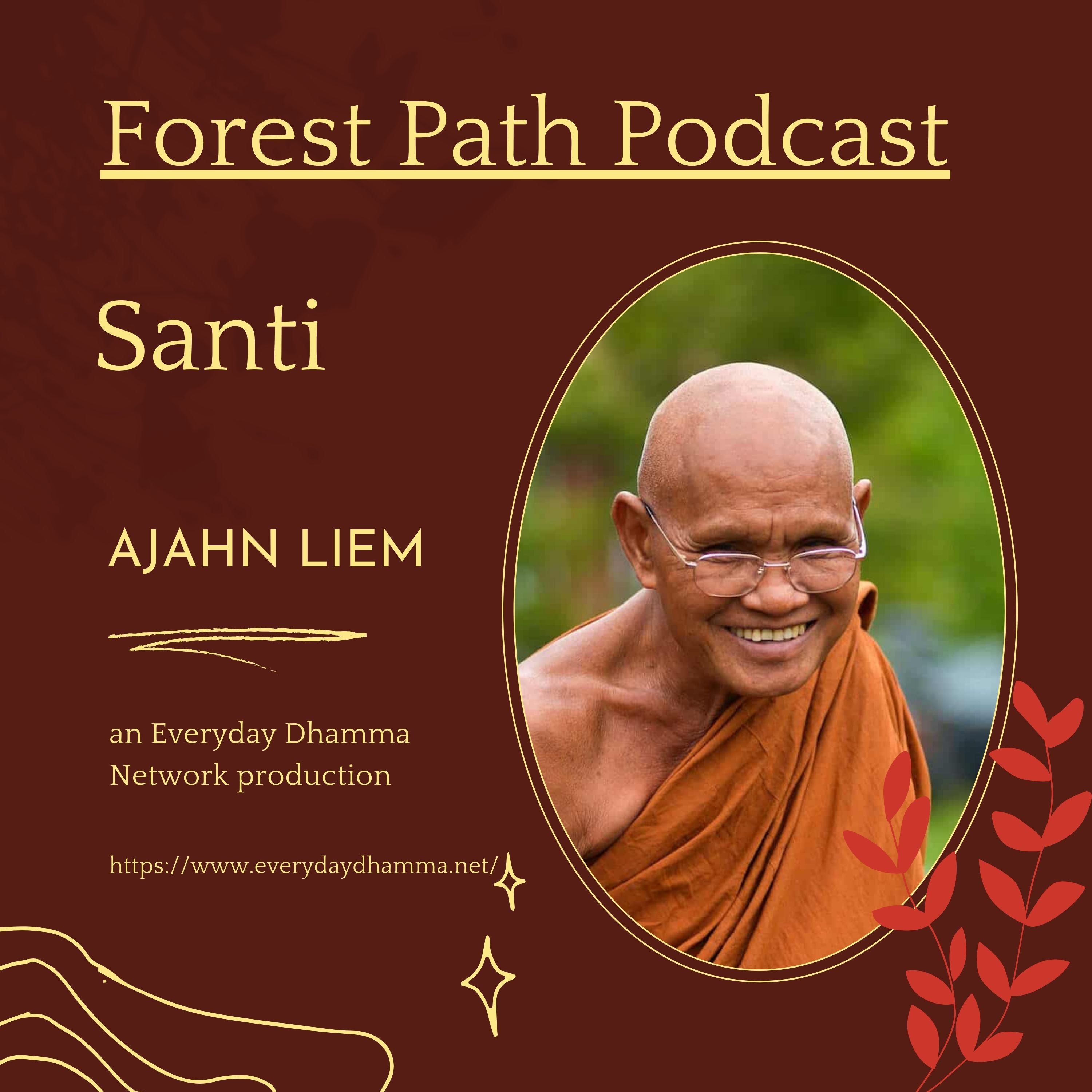
[00:00:09] This episode is a talk given by the Forest Meditation Master Ajahn Liam, and it's titled Santi, which is the Pali word for peace.
[00:00:19] It was published as part of the book Peace Beyond Illusion.
[00:00:23] You can find links to the original in the description below.
[00:00:27] May you all benefit from hearing this gift of Dhamma.
[00:00:39] Santi, a Dhamma talk given to the monks and novices of Wat Nong Phapong by Ajahn Leem the practice of insight meditation Vipassana is for the purpose of making things bright and clear, like turning on a switch to light up a room.
[00:00:59] In the light, one can see everything as it is, plainly and clearly in accordance with its characteristics.
[00:01:07] Vipassana is the practice of developing clear seeing for the purpose of true knowledge and the ending of delusion.
[00:01:15] Its development requires determination of mind, restraint and patience, qualities which are built upon a foundation of faith and confidence.
[00:01:25] When one's mind is determined, diligence and energy naturally flow.
[00:01:30] But if one's mind is not determined, laziness and excuses based on self importance gain the power to drag one into decline.
[00:01:40] Before the practice of vipassana can make one's understanding bright and clear, it is necessary to establish the supporting components in the practice. One must consider both the external conditions of one's environment and the internal conditions of one's feelings.
[00:01:58] If one doesn't consider both, then one won't make progress.
[00:02:03] As such, one might compare this practice to the work of a farmer.
[00:02:09] Farmers need to take the season, the environment, and the location into consideration in order to do their work.
[00:02:16] The crops are dependent upon the season because they require water.
[00:02:21] The rainy season is therefore the most appropriate season for planting rice, but the field has to be well prepared. The farmer must make it ready first.
[00:02:30] The tools and methods for working the rice fields are numerous and varied. As one can see, it takes many months to care for before the rice will mature, and then much effort must be made in transforming the grains of rice into a useful product.
[00:02:48] The work must be done carefully, according to the correct methods and appropriate techniques.
[00:02:54] The work of our practice is the same.
[00:02:57] It's important for us to understand the purpose for which we are practicing.
[00:03:02] The purpose is santi.
[00:03:05] Santi means tranquillity or peace.
[00:03:08] There are other forms of happiness which are easy enough to understand.
[00:03:12] For example, building a dwelling to ward off heat and rain provides comfort for the body.
[00:03:18] This is material happiness.
[00:03:21] However, the teachings of the Buddha point towards the happiness of freedom.
[00:03:25] Freedom from attachment, freedom from the stains of delusion.
[00:03:31] When one's heart is freed from burdens and attains to purity, it rests within its own peace and tranquillity.
[00:03:38] This is called santi.
[00:03:41] Santi, or peacefulness, is achieved through the process of bringing things to a state of readiness.
[00:03:49] It requires training in diligence and effort, both on the coarse and refined level.
[00:03:56] The coarse level involves taking care of bodily conduct, manners and speech.
[00:04:01] The refined level refers to taking care of the thoughts and feelings which arise, many of which are tainted, unwholesome or putrid, what the Buddha calls the asavas.
[00:04:14] Dealing with these requires the use of refinement.
[00:04:18] One must understand both the coarse and refined aspects and make use of methods for sifting and straining.
[00:04:25] Just as with unclean water, which must be filtered, making use of a coarse straining process will give us coarse water.
[00:04:34] But if we make use of a refined process, we will get a finer and finer product.
[00:04:40] As such, filtering with various mineral elements results in increasingly clean water.
[00:04:47] Our practice is just the same.
[00:04:51] We must establish principles and maintain guidelines.
[00:04:55] In this place, we have a daily routine for practice.
[00:04:58] When it comes to the appropriate time. In the evening, we have a bell to call us to awareness of our responsibility.
[00:05:05] It's a signal that it's time to put down other activities, both personal and group matters, which are external concerns.
[00:05:13] We cut off our various worries regarding these things.
[00:05:17] Our task now is to come and work in a more refined level.
[00:05:21] We must rely on determination of mind and the application of diligent effort.
[00:05:28] Therefore, we gather together with our minds made up.
[00:05:32] Having showered at 4 o' clock and hearing the bell, one puts on one's upper robe with one's right shoulder uncovered as a sign of respect.
[00:05:41] If one is a fully ordained monk, or one places one's folded outer robe over one's left shoulder, one also brings along any other necessary requisites. One establishes a wholesome intention and a positive attitude.
[00:05:57] One's intention is to deactivate selfish views, such as various forms of laziness and unwillingness to participate.
[00:06:05] One makes the effort to trim off these negative aspects.
[00:06:09] One One sets one's mind on practicing with reverence and respect, with motivated effort.
[00:06:16] But in spite of this, there may still be obstacles.
[00:06:21] However, they can only obstruct those who are weak.
[00:06:24] Those who are strong won't be hindered by obstacles because they won't see them as matters of significance.
[00:06:31] Those who are weak or infirm may see such matters as significant, and accordingly, they become obstructions.
[00:06:39] But those with a sense of momentum won't see them as such won't give them importance because they aren't matters which lead to internal benefit.
[00:06:49] Having come to the sala, we have made up our minds to sit.
[00:06:54] We bow to pay our respects and then we sit. Meditation.
[00:06:59] We apply effort in the sitting posture.
[00:07:01] This refined posture will lead us into a state of knowing and seeing. At the beginning level sitting, we find that there are still difficulties to overcome.
[00:07:11] At times, the body itself presents an obstacle which the Buddha described as kandamara.
[00:07:19] As we know, the word kanda translates as groups or aggregates.
[00:07:23] This mara or obstruction then is known as kandamara.
[00:07:28] It remains an obstacle for those who are not yet steadfast in their dedication.
[00:07:33] Feelings of weakness, sickness, fever, aches and pains, hunger, thirst, discomfort, flies and mosquitoes, heat and cold can arise.
[00:07:45] These are feelings which the weak person sees as obstructions.
[00:07:50] The strong minded person, focused, sincere and determined, doesn't see such things as obstacles, but as ordinary worldly matters.
[00:07:59] If we free ourselves from the conditioned realm, there will be no khandhas and therefore no aches and pains.
[00:08:07] Aches and pains inevitably accompany the Kundas fever. Sickness, threats to one's health come along with this group of elements that we call the body.
[00:08:18] It's not possible to have a body without having such problems.
[00:08:22] Where would you have such things arise, if not right here? With the body?
[00:08:28] We observe such conditions with the attitude that they don't constitute a problem for us, but are simply a necessary component of life. With this body, it's not necessary that we see such things as problems or obstacles. In our training, we must have a sense of restraint and tolerance.
[00:08:48] When we sit, the heart may again be prone to the five hindrances, for example, attachment to the various strands of sensuality.
[00:08:57] If one gets lost in anxieties and possessiveness over material objects, afraid they'll be lost or stolen and one will be left lacking, then such compounded thoughts will steal away one's sense of determination.
[00:09:12] As such, we cast aside such external matters.
[00:09:15] Such matters are like the outer layers of bark, not the heartwood, and won't lead us to peace, to santi.
[00:09:23] So we cut them off and throw them aside.
[00:09:26] We learn to regard disagreeable physical feelings and discomforts as simply ordinary affairs of the body.
[00:09:33] We have to experience pain and sickness because they are a natural part of the ordinary state of all conditioned things and as such they cannot be avoided.
[00:09:43] With this determined mindset, we strive to abandon the hindrances, including the various kandamaras, in order to be free from concerns, free from the worries that tarnish the mind.
[00:09:55] We apply our determination to practicing with diligence to fulfilling our responsibility of building the causes for knowing and seeing the causes for santi.
[00:10:06] Actually, we already have all of the component parts necessary for our practice.
[00:10:11] It's not the case that we don't have what we need.
[00:10:15] But the reason that our practice has not yet come to fulfilment is because our mindfulness and clear comprehension are deficient.
[00:10:23] These two qualities are of great support.
[00:10:26] They are supportive in giving rise to alertness and self awareness which is not an easy matter because of the distracting power of the mind's objects.
[00:10:36] Therefore, we should work at building up mindfulness and clear comprehension.
[00:10:41] Previously we've allowed the mind to freely follow its objects which arouse and incite not allowing it a stable base.
[00:10:51] Now we try to build up mindfulness and wisdom by taking up a single mental object as a basis for struggle.
[00:10:59] There are obstacles, but we build up a sense of determination and apply our best effort.
[00:11:06] Focusing our attention on a single object brings brings energy to our practice and gives it a solid foundation.
[00:11:13] It also provides a strong defense against the various distractions.
[00:11:18] The meditation object that we take as a basis for developing self awareness is something which exists within this bodily formation as one of its elements.
[00:11:29] The wind element which we breathe in and breathe out makes a suitable means for bringing the mind to peace free from the hindrances. Ready for the practice of vipassana or insight.
[00:11:42] When one pays one's respect before sitting meditation, one should say to at this time, I will watch over, supervise and take care of the mind. Warding off all of the formless attackers.
[00:11:57] Those attackers are the mental phenomena which arise according to conditions.
[00:12:03] They have no form, but nevertheless must be dealt with.
[00:12:07] Dealing with them requires the use of a refined, solid and firm mental object.
[00:12:12] Having selected the breathing process as our object, we focus on knowing in the in and out breath.
[00:12:20] When we breathe in, we know we are breathing in. When we breathe out, we know we are breathing out. We we have a feeling of being with both the in and out breath.
[00:12:32] We must be sure not to allow obstructive things to come in and block the way.
[00:12:37] Don't let them stumble into this protected area.
[00:12:41] Ordinarily, if we've come so far as abandoning the various kinds of worries that tend to arise, we're apt to lose our attention and allow the hindrance of drowsiness to take over.
[00:12:53] We we must maintain awareness and keep the activity of the mind clearly in focus.
[00:12:59] Its thoughts and feelings, impressions and formations can cause us to slip up and lose Our awareness.
[00:13:07] We then get caught in a mood or a mode of thinking or get distracted by external objects by way of the ears or the eyes.
[00:13:16] If our awareness isn't firmly established, we we can be led off away from the path and then beset by the hindrances on all sides.
[00:13:26] Proliferation, irritation, restlessness, doubt and hesitation.
[00:13:31] Even sensations of aches and pains as the body is breaking, the urge to urinate, the urge to defecate, feelings of sluggishness and unwillingness to make the effort.
[00:13:44] All of these things come up.
[00:13:47] If we don't have strong determination of mind, such things can carry us away.
[00:13:52] We should apply our decisiveness of mind.
[00:13:55] When such symptoms arise, we must quell them with the use of a parikamma or meditation word.
[00:14:02] We bring it up as a nimitta, a sign of the mind without making a sound. But by setting up a sign in the consciousness, we recite bud on the in breath and do on the out breath.
[00:14:17] Once we've worked hard to establish buddho thoroughly, fully and completely there will be no such thing as obstacles or obstructions.
[00:14:26] We then change our focus and give our attention to the mind and its objects.
[00:14:32] We rely on that self awareness which truly knows with alertness and readiness.
[00:14:37] But most commonly problems will overwhelm us at this point.
[00:14:41] Because we loosen the reins. We slacken our effort, easing up our attention. Craving infiltrates and takes a hold.
[00:14:49] If we don't slacken our effort and don't let craving take over, there will be no problem.
[00:14:54] We shift our attention to the mind and focus on knowing what mind consciousness is.
[00:15:01] It may seem that we refer to the mind as a material object, but in fact it is not.
[00:15:07] The process of consciousness is the immaterial function of the mind. Receiving impressions of the senses like sight, hearing, smell, taste, touch and mental formations.
[00:15:19] We observe these sense consciousness and recognize it simply as just one part of the material and immaterial components that we take as a self.
[00:15:30] The knowledge which arises from observing the mind strengthens our awareness and and our sense of readiness to respond.
[00:15:37] We don't follow the unwholesome mind, we dismiss it. We follow the wholesome mind which supports those components that create a sense of destroying the world of self.
[00:15:48] We investigate all the functions of the mind, recognizing them as impersonal, observing them without grasping them as this or that.
[00:15:59] If the mind is wholesome, it it will seek to simplify and reduce.
[00:16:03] It will clear away waste, not permitting feelings of owning or being to arise.
[00:16:09] The wholesome mind engages its objects with awareness.
[00:16:13] It doesn't engage without awareness, self awareness is present.
[00:16:18] As a result, our practice gives rise to increasing firmness and strength.
[00:16:23] Just as rice seeds having been scattered throughout the field, we, with all the supportive environmental conditions of rain, water, fertilizer, atmosphere, sunshine, and the correct timing, will not succumb to disease, but will sprout, flourish, and develop strength and immunity.
[00:16:42] So too, this practice flourishes in the same way.
[00:16:46] One's awareness is well established in every mind moment, and one has a feeling of resolution and courage.
[00:16:53] There's no concern for external things such as the body.
[00:16:57] No matter how long one sits, it's no cause for concern.
[00:17:01] One doesn't see it as something of importance.
[00:17:04] One views seeing and knowing, the state of seeing and knowing, as the thing of importance because it is there that one feels that the various problems can be cut off, where one's experience of such problems will be ended.
[00:17:18] This, then, is one cause for the arising of knowledge and vision.
[00:17:24] The Buddha taught that we should maintain mindful awareness at the moment of sitting, at the moment of observing, at the moment of knowing, and at the moment of seeing.
[00:17:36] When we are observing or knowing, what is that like?
[00:17:39] When we see, what is that like?
[00:17:42] Having seen, what do we take away with us?
[00:17:46] True seeing, the Buddha said, is seeing with right view, is seeing with emptiness, free from grasping and attachment.
[00:17:55] When we see mental objects, we see them as insubstantial and unbeneficial for achieving peace.
[00:18:02] Therefore, we set them down and don't engage with them any further.
[00:18:06] The mental objects are thus put to rest according to the level of our practice.
[00:18:13] As far as our practice develops, the mental objects are quenched to that level.
[00:18:18] Our practice distinguishes the mind from its objects and the mind objects from the mind.
[00:18:24] As such, the knower, the seer, and the beer are viewed as separate aspects. They exist together as states of knowing, seeing, and being that can be observed in this process.
[00:18:37] There is the method of our practice, the state of seeing and the state of being.
[00:18:43] Once this distinction is made, there is nothing that can stain the mind.
[00:18:48] The state of the mind and its objects can be recognized and identified.
[00:18:53] The knower is the one who knows the mind as the mind and the mind object as the mind object.
[00:19:00] Mental objects are therefore not capable of causing the knower to err or stumble after them.
[00:19:07] This is the kind of knowledge which arises.
[00:19:10] One sees each object of the mind as empty of substance, as a mere deceit, mere illusion, something meaningless, like a child's toy.
[00:19:20] One doesn't see it as having any value.
[00:19:24] One's inclination is to set such things down Lay down the mental objects delight in the mental objects doesn't occur.
[00:19:32] Dislike for the mental objects also doesn't occur.
[00:19:36] There is peace.
[00:19:38] This is the peace of seclusion.
[00:19:42] Just as in the nighttime there is seclusion.
[00:19:45] Seclusion from people coming and going without people around, it is quiet and peaceful.
[00:19:51] This is just the same.
[00:19:53] Although our faculty of perception is still in place, mental phenomena simply don't take over.
[00:19:59] One exists in a state of emptiness, with equanimity, free from self.
[00:20:05] There is no being, no person, no liking or disliking, no love, no hate or anger. It's a cool and refreshing abiding with a feeling of great peace and seclusion.
[00:20:19] This experience is Santi.
[00:20:21] The peace of Santi awareness is still present and complete. But. But one has no desire or thirst. Like a traveler who has reached their destination and set down their load, one isn't thirsty, one is without thirst.
[00:20:37] There is no such word as thirst. It doesn't exist.
[00:20:41] Everything shifts and goes to a state of peace.
[00:20:45] Self awareness was the instigator of this process of development.
[00:20:49] Now, when mental objects appear, our awareness is in place, so they present no danger.
[00:20:56] If one faces obstructions, hindrances and difficulties in this practice and finds oneself unable to see or understand, it's because the determination of mind isn't sufficient.
[00:21:07] The sweeping and dusting, wiping and mopping hasn't been done.
[00:21:11] The feeling of firmness hasn't been achieved.
[00:21:14] It's as if one's dwelling place isn't clean.
[00:21:17] One feels apprehensive in such a place, one but once it is clean, one feels confident and unafraid.
[00:21:25] Therefore, as time passes by, we try to achieve this.
[00:21:30] It's not a difficult matter.
[00:21:32] The Buddha taught that when one practices to the point of attaining to santi, meaning peace and seclusion from mental defilements by having cut them off completely, one will then live with a feeling of self worth, brightness of the heart, wakefulness and cheerfulness.
[00:21:49] Nothing will cause any feeling of impurity or suffering.
[00:21:53] Even when the bodily formation undergoes change, it's only the elements of nature which change.
[00:21:59] The state of the internal experience remains unaffected.
[00:22:03] This is something we must try to achieve. It is a goal which is not near yet not far.
[00:22:10] This can be understood when we read about the four foundations of mindfulness, the qualities of a Dhamma practitioner practicing for the sake of knowledge and vision.
[00:22:20] We can see that the Buddha said, if one practices continually without letting up one's mindfulness, one can expect results according to the following if progress is quick, within seven days on the moderate Level seven months, and in the slowest case, seven years.
[00:22:39] This is the time allocation the Buddha gave.
[00:22:43] It may be only a framework which he outlined, but if we practice continually in this way, then we must surely have the opportunity to attain results.
[00:22:52] We should give serious thought to this and put forth much effort. If we don't do it or feel we can't do it, that's foolish, really foolish.
[00:23:02] Because the Buddha's teaching is not something we are unable to practice. It's something we are entirely able to practice, and that's why we should make the effort.
[00:23:11] When sitting meditation, try to stay with the object. Try to pacify other things which arise. Don't grasp at states of concentration. Samadhi simply aim to pacify arising objects. That much is enough.
[00:23:27] It's enough to give rise to a feeling of motivated energy just by putting such objects to peace.
[00:23:33] If you have difficulties, it's because of the thicket of obstacles and illusions that are rooted in the past.
[00:23:40] These thoughts and memories will insist that they belong to your self, unsettling you to the point that you feel you can't sit or stand still.
[00:23:49] You perceive no peacefulness, only frustration, restlessness, and agitation.
[00:23:55] This is particularly the case for those who come to ordain for a limited time period.
[00:24:00] One feels one has already achieved one's goal of ordaining and left simply waiting for time to run its course.
[00:24:07] Negative thoughts and feelings inevitably arise.
[00:24:10] These feelings are an obstacle to one's practice, to fulfilling one's responsibility.
[00:24:16] But in spite of these things, we must make the effort to train.
[00:24:20] I also trained for a period as one newly come to the Dhammaran discipline according to tradition.
[00:24:27] But doing the practice soon helped me to see its value.
[00:24:30] However, I didn't really know what I was doing.
[00:24:33] I didn't see any sign of peace or any sign of happiness.
[00:24:37] All I saw was chaos and frustration.
[00:24:40] As for peace and seclusion, there was no sign.
[00:24:44] Sitting down, it was as if I found myself in the most dangerous of places.
[00:24:49] There was no coming to grips with my feelings, either sitting or standing. It was a great ordeal.
[00:24:56] But still I had a feeling that when the Buddha taught, he didn't teach for any personal gain. He. He taught only in terms of things that he himself had already experienced.
[00:25:06] So I made the effort to determine my mind.
[00:25:09] I would think to myself, whatever must be done today is what I'll do.
[00:25:15] Whatever must be done day by day, according to the time and opportunity.
[00:25:20] That's what one should do.
[00:25:23] My first attempts, when all is said and done, didn't get Me, anywhere.
[00:25:28] I didn't know what I was doing, therefore my efforts weren't effective.
[00:25:32] I was practicing like a trader with no skills who uses only brute force.
[00:25:37] In the Isan language, they call such a person a two fisted tradesman.
[00:25:42] I was simply putting forth effort, not knowing whether or not I would succeed.
[00:25:47] When the time came for sitting, I would sit. But I didn't see any peace within.
[00:25:52] All I saw was chaos. And memories, images and ideas kept building up in my mind as I sat. Sometimes desire would pull me into developing schemes and projects, as if I must lay a plan to achieve this or that.
[00:26:08] One moment I was building up an idea, the next moment it would collapse and disintegrate.
[00:26:13] That's the way it felt.
[00:26:15] Should I ever act upon such thinking, the proliferation would go on and on without stopping. But both day and night.
[00:26:22] But I kept on making the effort to practice. Even if there were to be no results, I had to keep trying, keep persevering with patient endurance.
[00:26:32] This is the point where one must dig for treasure. But having dug in, if there is only dry earth, no sign of treasure. The earth is hard and there are rocks as well. One sometimes feels discouraged.
[00:26:46] But I kept on trying to.
[00:26:48] Sometimes various hindrances and memories would pull me into thinking I was hopeless and out of luck.
[00:26:56] Sitting there like one, with no sense and no mindfulness, wondering what it's all for. But even so, I kept on trying.
[00:27:04] And when I looked back at the past efforts I had accumulated, it became an increasing source of inspiration.
[00:27:11] Sitting there was nothing else to use as an object of concentration. So I would light a candle as a focus.
[00:27:19] At first it wasn't a very long candle, just an ordinary white candle like those that the lay people offer.
[00:27:26] I used it as an object, sitting until the candle would burn out.
[00:27:30] I didn't sit in a windy place. I lit the candle in a place where there was no breeze, where the flame would stand upright, straight.
[00:27:38] I would sit and gaze at the flame, thinking, what is it that causes this flame?
[00:27:44] This was the sake of clearing away all distractions and memories, looking at the flame and the halo around the flame, looking and contemplating.
[00:27:54] This flame has fuel, therefore it ignites. With no fuel, it would not ignite.
[00:28:01] I took fire and the impression of the flame as my object.
[00:28:05] It was a means of destroying mental formations based on the past and an aid to increasing awareness in the present.
[00:28:13] I made effort with this both day and night.
[00:28:15] Whenever there was sufficient time and I wasn't tied up with external duties, I would train in this way.
[00:28:21] Four days Five days at a time, constantly chopping and changing. But it was a lot of suffering.
[00:28:28] Sometimes various feelings would arise based on defilement and craving.
[00:28:32] These feelings seemed never ending. I didn't know where all the desire was coming from.
[00:28:38] There was so much of it, so much to endure. Like an enormous mountain on top of me, crushing me into dust.
[00:28:45] There was no way out, no means of escape.
[00:28:48] Watching and observing brought up the suffering. Whether sitting, standing or lying down, there was suffering.
[00:28:55] But I stood firmly on the principle that the Buddha would not lie and kept in mind that my teacher also encouraged this fairy practice.
[00:29:04] So I practiced not seeing any avenue which might be a means of breaking through, but simply keeping at it.
[00:29:12] Once I came to the point of feeling that the obstructions and distractions had calmed and settled down a little from time to time, I was able to gain a perspective on myself.
[00:29:23] To some degree, I could perceive internal peacefulness.
[00:29:27] The samadhi object, like a distant twinkle, though not yet constant or consistent, would arise. When self awareness was sufficient to establish peace, I carried on practicing.
[00:29:39] By this point, I had a few means for overcoming the various obstacles which would arise. I also had a good teacher, giving instruction and leading by example.
[00:29:49] Therefore, the various obstacles weren't too overwhelming.
[00:29:54] I carried on doing my own practice in this way.
[00:29:57] Upon returning from the group meetings and coming to my hut, I went on with my own training.
[00:30:03] I made use of all means possible to give rise to secluded peace.
[00:30:08] In those periods of warfare, battling with the proliferations, I would pick up and use a weapon, anything which might be an aid to survival.
[00:30:17] All of the various reflections and contemplations that we review together, should they bring up any kind of reaction, I would take that reaction as a focus for practice.
[00:30:28] I would practice to attain peace and practice to attain insight.
[00:30:34] Where one's work of study and investigation lies, the work of contemplation for insight also lies there as such. Anything which would help in bringing together my sense of awareness. I practiced diligently, but I was still conscious of obstacles from, for example, the various feelings which arise relating to little things such as eating.
[00:30:56] Even small matters like this, though nothing major, are difficult to manage.
[00:31:02] At that time, our community used the system of dishing out each kind of food in equal parts to each member.
[00:31:09] This took away the opportunity to follow one's wishes, one's feelings or desires.
[00:31:14] We used this method at that time because there were few monks and novices and and the food was limited, so we had to do it that way.
[00:31:23] Also, the monastic rules regarding the distribution of food required that we do it that way.
[00:31:30] But these days we can see that the food offered is sufficient for one to select for oneself.
[00:31:36] But the limitation lies in taking just the right amount for oneself, a skill which is called bhojane matanyata.
[00:31:44] This is also difficult to do.
[00:31:47] Many of us, even practicing this method for some time, still can't get it just right.
[00:31:52] We should consider this matter of eating is simply what we do to give the body the support it needs to get by for another day.
[00:32:00] There's no sense in clinging to some foods as good, others as bad, some as refined, others as coarse, or even seeing what we eat as food at all.
[00:32:10] It is rather a nutriment for the body to maintain its state of usefulness. There's no point in making anything of the issue of eating. It's not an issue to be concerned about. And there's no point in worrying over the body whether it will be like this or that. It's not necessary to burden oneself with such worries.
[00:32:30] This body shouldn't be taken as belonging to oneself.
[00:32:34] It is simply a state of nature, a manifestation of material form and and nothing more.
[00:32:42] Even if one were to give sustenance to the body, to the full satisfaction of one's desires, in the end, the time would still come for its inevitable demise.
[00:32:52] This much we can all see.
[00:32:55] However small matters like this remain difficult. It's not the case that they are easy.
[00:33:01] The feeling that one kind of food is good, another kind not good, or one kind of food is suitable, another kind is not suitable, was still present within and not willing to abate it, was still a concern, still an obstacle, even though it shouldn't be.
[00:33:18] One should be concerned with deeper, more meaningful things than this.
[00:33:22] This matter concerns only the coarse material elements and nothing more. It's not a big issue, but it is still difficult to manage.
[00:33:31] Knowing moderation and eating means not allowing food to become a cause for worry.
[00:33:37] One consumes what one is given in a simple and orderly fashion, not making oneself a burden for the hearts of lay supporters.
[00:33:45] If one selects one's own food, one should attempt to take the right amount suitable for one's body.
[00:33:52] This is something we should all try to do.
[00:33:55] As I work to consolidate my feelings regarding this external matter, I. My internal awareness became more and more refined.
[00:34:03] I tried to build on and make much of this refined awareness in order to increasingly sift through the various feelings.
[00:34:11] The feelings kept on arising, and I was weighing them up and evaluating them all the time while eating. What feelings would create disturbance before eating? What feelings would irritate and interfere.
[00:34:25] The various disturbances are simply vedna Pleasant and unpleasant feelings.
[00:34:31] The unpleasant feelings of hunger and thirst would arise in various forms.
[00:34:35] At times, pleasant and unpleasant feelings expressing satisfied and dissatisfied states of the body would compete for my attention.
[00:34:45] Feelings of liking and disliking. This is agreeable. This is not agreeable.
[00:34:50] Lung Po Cha therefore had us contemplate unpleasant feelings.
[00:34:55] The experience which arises before eating, what is that like?
[00:34:59] It is unpleasant feeling.
[00:35:01] One is hungry, one is thirsty.
[00:35:04] One knows nothing but desire.
[00:35:07] But one has to have patience and tolerance and restrain oneself until it is time for eating.
[00:35:13] When it was almost time to eat, we had the practice of contemplating our food.
[00:35:19] We didn't organize our food into separate vessels or all of one's food was mixed together into one's bowl.
[00:35:26] All of one's food combined together, discouraging feelings of this is good, this is average, this is not good.
[00:35:34] All the different types had to mix together.
[00:35:37] Then we would contemplate the disgusting nature of food for the purpose of abandoning delight and giving up Feelings of not having enough and not being content with what one has or what one gets.
[00:35:49] I contemplated in this way in order to conquer feelings of hunger, thirst and desire all of which are demands which present an obstruction to peacefulness.
[00:35:59] Then, while we were eating, Luang Pho had us continue to contemplate and observe.
[00:36:06] Naturally, when one eats, one seeks for pleasant flavour in one's food.
[00:36:10] One seeks for the flavour that one likes, that which one finds satisfying if one isn't satisfied. Sweet is no good, salty is no good. Sour is also no good. It's like that.
[00:36:25] Then, having eaten, the process continues. Pleasant sensations arise and pleasant moods arise. The pleasant mood covers up feelings of suffering. It's just the same as when one changes posture. It conceals the unpleasant feelings of the body.
[00:36:42] If one doesn't change the posture, the body suffers.
[00:36:46] Happy states and unhappy states of mind are also like this, constantly changing and concealing each other.
[00:36:53] In this way, hunger and thirst hide pleasant feeling and pleasant feeling hides unpleasant feeling.
[00:36:59] Feelings and moods switch back and forth constantly, each preventing the true nature of the other from being revealed.
[00:37:07] So I observed, always diligently watching over myself. This was the focal point of my study and practice Continually watching myself with mindfulness, seeing happiness and suffering both as simply vedna as feelings or sensation one of the five khandhas which make up the illusion of a self.
[00:37:28] In this way, I observed my relationship to such feelings.
[00:37:32] If one engages with feelings in this way, one won't become a slave to wanting, a slave to craving. One is able to accept both gain and loss and the moods and feelings which follow on from gain and loss.
[00:37:45] One doesn't delight in or give importance to arisen mental objects. Neither is one intimidated or hindered by them.
[00:37:52] Such objects and feelings ease, attenuate, and can be abandoned.
[00:37:57] Just as when the clouds in the sky thin out, the sunlight shines more brightly, one's heart becomes more and more radiant and cheerful.
[00:38:06] It's as if one has cleared darkness and impurity out of one's heart.
[00:38:11] This practice is a matter that we must apply to our way of living.
[00:38:15] All the way up to our sleeping and waking.
[00:38:18] We engage mindful awareness to both our sleeping and waking.
[00:38:22] We engage with a sense of knowing, not with unknowing.
[00:38:26] This in turn gives rise to a feeling of seeing according to the truth.
[00:38:31] Whatever should arise, one sees the truth in it.
[00:38:34] That truth points towards the tilakana, or three characteristics.
[00:38:39] The truth of all things gathers together in these three characteristics, which are consistent from the beginning through to the end.
[00:38:47] All conditioned things exist within these three characteristics.
[00:38:51] You probably know of these universal characteristics, Ani Cha. All things exist in a state which is impermanent, not lasting, and must undergo change.
[00:39:02] That's the state of things. They have to undergo change.
[00:39:06] We take a Nietzsche as the basis for vipassana. It's the basis for correcting one's view. Therefore, we must bring our attention to this point.
[00:39:16] Anitya translates as uncertain, unstable and impermanent.
[00:39:21] Whether it's happiness or unhappiness, achievement or loss, it is if we engage in the manner of craving, we can only suffer.
[00:39:28] We all know about suffering. Suffering means discomfort. When discomfort arises, it comes from desire.
[00:39:36] Desire comes from a feeling of depletion, depletion, thirst, not recognizing fullness, not knowing enough.
[00:39:44] All of this the Buddha called tanha or craving.
[00:39:47] If we don't know enough or recognize fullness, then that is a source of suffering.
[00:39:54] We become slaves to our moods and feelings, to the agreeable and disagreeable mental objects which continually arise according to causes and conditions.
[00:40:03] This is a matter which we should try to understand.
[00:40:06] We should investigate the three characteristics as much as we can investigate a nicha instability, both on the material elements and of the immaterial dhammas.
[00:40:19] Whatever mental objects arise, the Buddha said to take the tilakhana as a basis. It's a sword for cutting down the various enemies and maras which arise, so one should have it at the ready. If we engage with states of dukkha, of discomfort under the influence of craving, then we suffer.
[00:40:38] But if we engage with the power of knowing, there is no suffering.
[00:40:43] By and large, people engage under the influence of craving and therefore suffer.
[00:40:48] Amitta translates as unstable.
[00:40:51] Dukkha consists of those things which are difficult to endure.
[00:40:55] Anatta means not constituting a self.
[00:40:59] We must take this understanding as our basis.
[00:41:02] All things are unstable, whether pleasant or unpleasant are things without an identity or a self are anatta Dhamma.
[00:41:10] We must bring our feelings into accord with these characteristics when there won't be anything which will give rise to churning turmoil, chaos and confusion.
[00:41:21] Direct knowledge must depend upon the three characteristics for its arising.
[00:41:27] If our view is to become right view, it must depend on the three characteristics.
[00:41:32] Without the tool of the three characteristics, these things are difficult to achieve.
[00:41:38] The Buddha therefore instructed that we keep this tool on hand for the purpose of our practice.
[00:41:45] This tool is for Dhamma practitioners, not for people of the world.
[00:41:49] It's for use by those who are practicing to destroy the various things which constitute obstacles to peace and freedom.
[00:41:57] It's not something which worldly minded people can make use of. Worldly minded people aren't like that.
[00:42:04] They don't do what they do for the sake of santi. They simply attempt to achieve what the world sees as happiness.
[00:42:12] That's what they want. But santi, to which the Buddha attained, destroys the root of worldly happiness.
[00:42:19] The Buddha said, this is the path to give rise to right view.
[00:42:23] Therefore, as we develop along the path of practice, we must exercise great patience.
[00:42:30] I feel very comfortable living alone and secluded. There is nothing to tie one down. There is nothing to give rise to worries.
[00:42:38] This is a different feeling to that of regular people.
[00:42:41] This is a feeling of peaceful seclusion within oneself.
[00:42:45] It's the same as a person with no sickness or disease who is untroubled by stress and worries.
[00:42:52] A sick person, whether lying down, standing, sitting, or walking, worries all the time. They are afraid that they are in danger of death.
[00:43:00] But someone with no feeling of stress or worry regarding sickness is experiences peace and ease.
[00:43:07] There is thus a difference which I illustrate as a comparison.
[00:43:12] One person has no feeling of anxiety regarding any issue. But the sick person worries and stresses out thinking only of their illness.
[00:43:21] Even if one speaks of them of enjoyable and interesting matters.
[00:43:26] Regarding this, as each of us still has a task to fulfil, we must make the effort to practice together.
[00:43:33] We must make increasing effort to carry out the role of a summoner, a peaceful one.
[00:43:38] We have been practicing together for some time now, sufficient for each to recognize what they personally are dealing with. But there is a lot of work remaining it is no small task when one is cleaning up the cleaner things get. The more clearly one can see the dirt in our practice, the more that peace increases, the more that one can see all kinds of danger in every corner.
[00:44:04] This is the way it is.
[00:44:06] This is the meaning of the word bhikkhu. One who sees the danger in the rounds of rebirth, one who recognizes danger is able to escape from danger. If one doesn't recognize danger, one is unable to escape.
[00:44:20] If one has this attitude, the then one's feeling of dispassion will increase.
[00:44:24] But it won't result in disappointment.
[00:44:27] One simply sees that this is the way things have to be.
[00:44:31] Clean water naturally still contains a lot of impurities.
[00:44:35] In clear and clean water, one can see all the dust particles, no matter how small they are.
[00:44:40] For as long as our feelings are still coarse, our outlook is also coarse. But if our feelings become more refined, our our vision becomes clearer and more refined.
[00:44:51] Finally, one sense of caution is ever present to the point that dirt is no longer capable of interfering with the cleanliness.
[00:45:00] The cleanliness exists as cleanliness. The dirt exists as dirt. They are separate.
[00:45:07] The cleanliness doesn't become involved with the dirt and the dirt doesn't become involved with the cleanliness. This is just the same.
[00:45:15] The peace of seclusion does not become involved with any kind of disturbance. The states of disturbance therefore come to an end.
[00:45:23] From the perspective of a worldly person, there always has to be disturbance. But from the perspective of one secluded and at peace, there is no trace of disturbance.
[00:45:34] In the same way, a person whose heart is in a state of having laid down every kind of burden is is left with nothing which will weigh them down.
[00:45:43] When a person has no more worries tightening and constricting around their heart, a feeling of spaciousness and freedom arises.
[00:45:51] This matter is something in which we must practice and train in order to make it a reality.
[00:45:57] If there are obstacles, we simply accept that difficulties must always come with something new.
[00:46:03] Like a new robe, for example.
[00:46:06] When a robe is newly dyed, the dye is not yet set fast, and any accidental spills or stains can easily ruin its appearance.
[00:46:15] Our practice is just the same.
[00:46:18] We must sift, strain and cleanse the heart in order to reveal its purity.
[00:46:23] We must work and strive to secure the heart's state of peace.
[00:46:27] Then all of the time that we've spent will have gone for good results and caused us to meet with that which we hoped for.
[00:46:36] We practice according to these teachings for the sake of goodness and for the sake of setting our lives upon the right path. We will then walk on a path which is smooth and straight and free from harm and danger.
[00:46:48] As a result, our lives will be rewarded with santhi, the peace and tranquillity of seclusion.
[00:46:56] Therefore, may may each of you who have made up your minds to carry out the practice be firm in your determination and in your efforts.
[00:47:13] That concludes the Dhamma Teaching Santi by the Venerable Ajahnleam.
[00:47:18] If you'd like to hear more talks by Ajahn Leam and other meditation masters of the Forest tradition of Theravada Buddhism, subscribe to the Forest Path Podcast using your favorite podcast app.
[00:47:30] The Forest Path Podcast is part of the Everyday Dhamma Network.
[00:47:34] If you go to everydaydhamma.net you can discover more about the other podcasts on the network. Also, this podcast is produced and narrated by Saul Hanna. If you like these audio resources that I'm making available for free in a convenient podcast format, you may also want to become a donor.
[00:47:54] And you can do that by going to the Everyday Dhamma Network website and clicking on the Ko Fi link.
[00:48:03] There are links in the description below as well.
[00:48:07] Thank you for listening. May you all experience insight and peace.
[00:48:17] Sa.