Episode Transcript
[00:00:00] Welcome to the Forest Path Podcast, a podcast sharing the teachings of awakened meditation masters of the modern era.
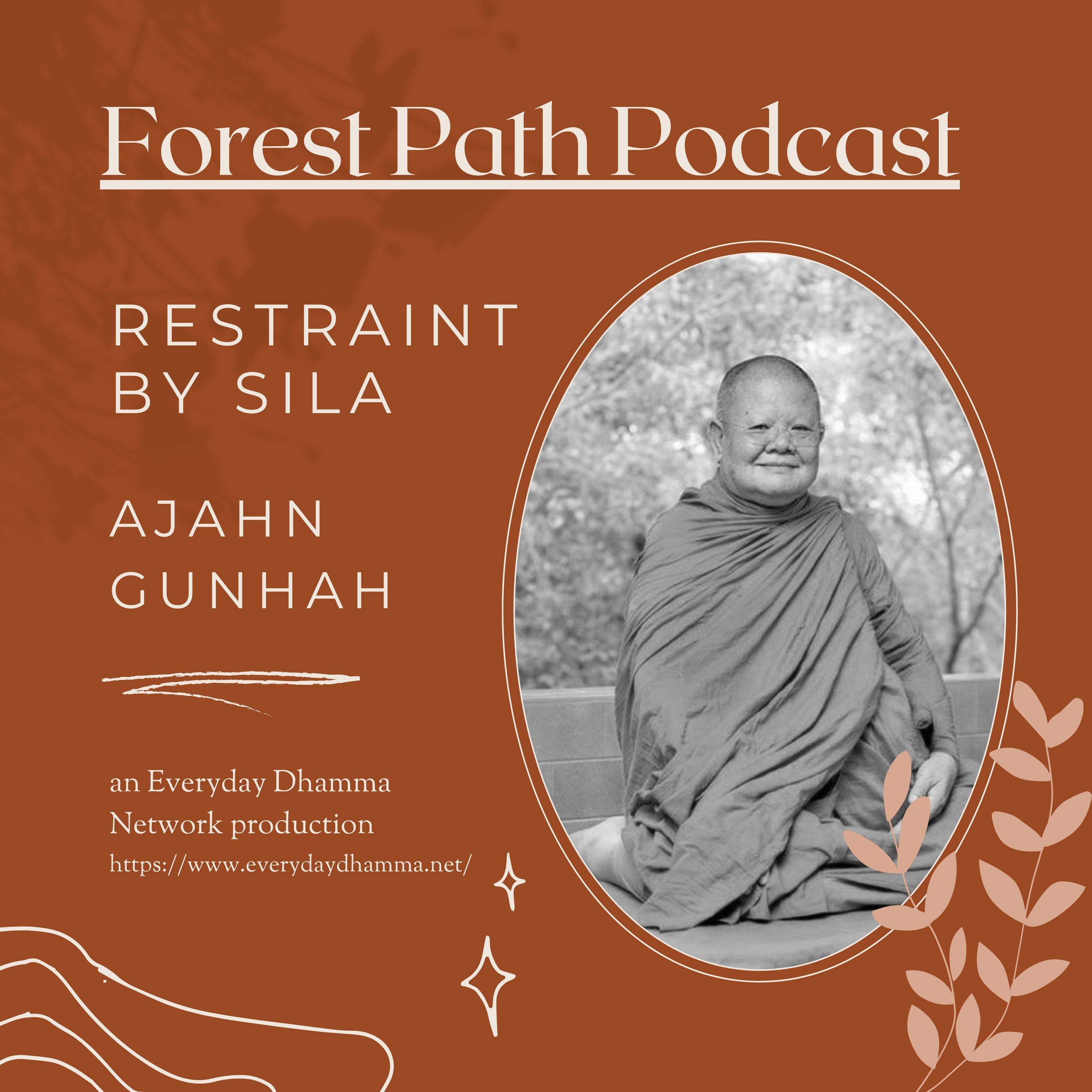
[00:00:08] This episode is a talk given by the nephew of Ajahn Chah, Ajahn Gah.
[00:00:13] The talk is titled Restraint by Sila. Sila here means virtue or morality.
[00:00:20] It was published as part of the book jaidee Jai Sabhai delivery 42 and made available for free distribution by Wat Pha Subdawi Dhammarang.
[00:00:32] You can find links to the original text in the description below.
[00:00:36] May you all benefit from hearing this gift of Dhamma.
[00:00:47] Restraint by Sila by Ajahn Gah out of loving kindness, the Lord Buddha wants everyone to practice Dhamma how to Practice the Dhamma Practicing Dhamma means behaving according to the Dhamma.
[00:01:05] It means not following your wants and needs because your wants and needs are causing you problems.
[00:01:12] They lead to the decline of your heart and mind.
[00:01:15] Your individual path of practice characterizes your life, your mind, your position and quality.
[00:01:23] Truth is truth. It has no bias towards anyone.
[00:01:28] Those who do good get a good result, those who do evil get a bad result.
[00:01:34] All beings exist in the world according to their Kamma.
[00:01:38] Nobody can avoid it.
[00:01:41] The Lord Buddha wants you to put emphasis on finding yourself when things get difficult and hard. No matter how tiring it is you, you still have to pursue your Dhamma. Practice restraining the sense faculties, controlling the eyes, ears, nose, tongue, body and mind to establish yourself in the Dhamma by not being careless.
[00:02:04] Clever people have to do it too. Because despite your cleverness, regardless of the knowledge and skills you have, you will still die if you don't give importance to the Dhamma and make it your principle and code of practice.
[00:02:18] Things don't happen according to your wishes.
[00:02:21] The Lord Buddha wants you to improve in body, speech and mind.
[00:02:26] You don't have to look for magga, phala and Nibbana or the end of suffering anywhere else. He wants you to come back to your body, which is your path of practice.
[00:02:36] He gave us the Noble Path, the Supreme Path that is the Noble Eightfold Path Path to make it our principle, our path of practice.
[00:02:47] All of you are looking for happiness, the end of suffering.
[00:02:51] But you can't overcome Dukkha because you haven't cured it in your body, speech and mind.
[00:02:57] In your path of practice.
[00:03:00] Whatever you do in your daily lives, there is always bad Kamma regardless of what you say, think or do.
[00:03:08] Even though other people don't know, don't see or can't hear it. The bad karma you have Made won't forgive you. Your bad karma will reach you for sure.
[00:03:18] Not only in this life, but also in the next life. That's 100% for sure.
[00:03:25] Whatever you do, at least you will know.
[00:03:29] Regardless of whether it's a secret or in the open, in front of others or behind their backs. You can't hide it from yourself.
[00:03:38] The Lord Buddha wants you to improve everything that is not correct or good in your heart.
[00:03:44] The Lord Buddha strictly forbade you to think.
[00:03:47] If you think, you will have problems for sure.
[00:03:50] The fact that you can't practice or reach the path and fruit is because of your thinking.
[00:03:56] It obstructs you from entering nibbana.
[00:03:59] How can you enter nibbana?
[00:04:01] It's the essence of the heart and mind that enters nibbana.
[00:04:05] Your heart is not yet pure. It is still dirty. It is still dwelling in the past and the future.
[00:04:12] It is delighting in forms, sounds, odours, flavours, gain fame and praise, not cutting them off or throwing them away.
[00:04:22] It still likes the world better than the Dhamma. How can it enter nibbna?
[00:04:28] The Lord Buddha wants each and every one of you to put emphasis on the heart.
[00:04:33] He wants you to go back to the heart and contemplate like.
[00:04:36] Is my heart established in the triple Jam?
[00:04:40] Do I feel ashamed about doing evil? Do I shy away from evil?
[00:04:45] Do I see the danger in Sasra?
[00:04:48] Have I stopped thinking about things that are not appropriate?
[00:04:52] If not, you must improve it. Because this is what we call a rough person, a shameless person.
[00:04:58] One who has no fear and shame towards evil.
[00:05:02] One who boldly thinks and proliferates in things. The Lord Buddha did not want you to think and proliferate.
[00:05:09] You are only doing a few things with the body that are evil and unrefined. But you create a lot of evil in the mind by thinking thoughts that are bad and improper.
[00:05:20] When there are many thoughts like this, how can you correct yourself when you do evil? You create bad karma by thinking all the time.
[00:05:29] You want to think, but you have to stop thinking.
[00:05:32] You need samadhi.
[00:05:34] Samadhi will obstruct and hinder thinking. Like a big dam that holds the water back and saves it for whenever you need it.
[00:05:43] Samadhi is an important and powerful tool.
[00:05:46] It releases you from your previous thinking that tells you it is not possible to stop thinking.
[00:05:53] You can't stop thinking because you haven't stopped and endured it yet.
[00:05:58] Kanti paramang tapo titika.
[00:06:02] Kanti means endurance. It is the foremost tool for burning the calasis Try to abstain, try to endure. Try to go against the current to develop the heart.
[00:06:15] You can't dwell in carelessness.
[00:06:18] Even being ordained for a long time is useless if you haven't practiced and solved your problems in an appropriate way.
[00:06:25] The Lord Buddha taught it is not too difficult. Everyone can practice, but they don't see the importance of practicing the Dhamma.
[00:06:34] You are lazy and selfish. You cling to happiness and comfort. But nature, truth, it doesn't make an exception for lazy people who cling to happiness and comfort.
[00:06:45] It doesn't allow you to put things off, saying, now the weather is too hot, it's chilly, it's cold, it's raining, or the sun is coming out.
[00:06:54] Everything has to happen according to the truth. In line with such a Dhamma, the Lord Buddha taught that things are already good.
[00:07:04] Such a Dhamma is the truth.
[00:07:07] You have to adjust your hearts and minds. Find the truth.
[00:07:11] Practice the Dhamma.
[00:07:13] The Noble Eightfold Path and the four kinds of Samana occur in your daily lives. Whether you are a lay person or monastic, everyone has an equal right to practice.
[00:07:25] You continue to have dukkha and problems because your behaviour regarding the good path is still incorrect.
[00:07:31] Your selfishness is still influencing your mind, your speech, your manners and your actions.
[00:07:37] You are still stupid, blurred and confused when you do something. You can't fully keep track of all the small things in your daily life if you practice. The Lord Buddha says, that's good because the happiness in your heart is a noble one.
[00:07:54] The stream enterer has more happiness than a rich person, one who might be a millionaire but has a heart of a worldling.
[00:08:03] No matter how much wealth you have, you still can't end your dukkha.
[00:08:07] When your heart is not peaceful, but you practice the Dhamma, your heart will become happy.
[00:08:13] Your family will be warm and happy. You have a house but are not deluded by it. You have a car but are not deluded by it.
[00:08:23] You have gain fame and praise, but don't get deluded by it.
[00:08:28] Because these things are external. They are temporary utensils. You have a body, but you aren't deluded by the body.
[00:08:36] This body is such a Dhamma. It is aging every day. There is aging, sickness, being uncomfortable and unwell every day.
[00:08:46] That's how it truly is.
[00:08:48] You can't rely on it.
[00:08:50] You use your mind and body to develop your heart so that it is able to separate the mind and body.
[00:08:57] When you age, you age in the body. You get sick and die also in the body.
[00:09:03] But Your heart is nma Dhamma. It has never aged, become sick or died.
[00:09:10] You have dukkha because your heart is deluded.
[00:09:14] It is misled into taking up and clinging to the body as being yours.
[00:09:19] That's indeed dukkha, a real problem.
[00:09:22] You have to train to let go in the heart. Thus I am not a woman, a man, a child or an old person. I am not anything at all.
[00:09:32] This here is a dhamma. A thing, a natural phenomenon. It arises, lasts for a while and then ceases all the time.
[00:09:42] Every breath and everything else. Nothing lasts permanently.
[00:09:46] Everything has to disintegrate in the end.
[00:09:49] The body is not yours. You have to learn to let go, to make the heart peaceful. To enter samadhi. Because smart and clever people are deluded by heaven. By gain, fame and praise. They don't know how to make the heart peaceful.
[00:10:05] They don't know how to let go.
[00:10:08] When the body is all right, they forget the body.
[00:10:12] When there is gain, fame and praise, they forget the body.
[00:10:16] This is called forgetting one's roots.
[00:10:20] The Lord Buddha taught, do not forget the body.
[00:10:23] The Lord Buddha did not forget the body and he became a Buddha. If you have forgotten the body already, there will be dukkha regarding children, grandchildren and relatives. Because you cling to the body as being yours.
[00:10:36] Then everything turns into a process of suffering.
[00:10:40] It is said that donating the body as Dana will bring great merit.
[00:10:45] Donating the body means letting go of sakaya ditti. Letting go of the wrong view. The body is me. It is mine.
[00:10:54] People are very selfish.
[00:10:56] When the body is white with delicate skin, you are glad. But one day you will lose the cosmetics or the jewelry that decorates you.
[00:11:04] You are deluded like this.
[00:11:06] Someone says that you are beautiful or handsome. You are deluded by it.
[00:11:11] Or they say that you are white and pretty and you are deluded by it.
[00:11:17] Lord Buddha taught that you were not born to accumulate delusion parami.
[00:11:22] You have to accumulate parami to reduce your sakya dt.
[00:11:26] Because your body is disgusting and filthy. You dress up to conceal the things that are disgusting.
[00:11:32] So that you can easily live among people.
[00:11:35] If you haven't taken a shower and got dressed, it is repulsive.
[00:11:40] Don't foster delusion. Try to let go of the body and sakaya ditti.
[00:11:46] Develop your heart.
[00:11:48] True happiness lies in a peaceful heart.
[00:11:51] Everyone has to develop samadhi.
[00:11:54] External matters such as who understands and who doesn't. Who is rich or poor, which problems will arise in politics, earth and heaven, weather and everything else doesn't matter.
[00:12:06] Train the heart to be peaceful.
[00:12:09] When you practice like this in your daily life, your heart will become peaceful and good qualities will arise.
[00:12:16] Adjust yourself according to what the Lord Buddha taught as a fixed principle, Sabha Papasaakarana, which means not doing any evil leads to the deathless.
[00:12:29] It has to be taken up and firmly integrated into your practice. If you are lagging behind, you allow time for making mistakes.
[00:12:37] You don't accomplish the wholesome.
[00:12:40] The Lord Buddha wants you to make your house the place of practice.
[00:12:44] For those who live in a monastery, that is their place of practice. Don't go wandering off far and wide to look for the Dhamma. It is in your daily life already.
[00:12:55] The Lord Buddha advised us to remember every day. Don't be forgetful, don't be careless.
[00:13:02] You have to go back to improving yourself, changing yourself.
[00:13:06] When you have any flaws, you tend to start blaming yourself.
[00:13:10] I have a little merit and not much luck, little parami.
[00:13:15] This is not right. This is not fair. Because everyone can do it. Everyone can practice.
[00:13:21] May you believe the Lord Buddha. May you follow the Lord Buddha.
[00:13:26] Everyone can do it. It can be done by everyone.
[00:13:31] There is a lot of old kamma, old habits and dhiti mana. You have to improve this.
[00:13:39] The Lord Buddha doesn't want you to play innocent. He wants you to be bold in practicing, in cutting off things, in improving yourself.
[00:13:48] He wants you to do it, to practice even if there are no witnesses. Because you will know and witness for yourself in overcoming the Khaleesis, bringing an end to the Asavas. You are the one who knows.
[00:14:03] There is no need to think that you don't want to be reborn, that you want to go to nibbana, because it doesn't matter what you think and want, it is useless. You only create evil and bad karma for yourself when you know, but you don't practice. You are clever in external things, but that is useless.
[00:14:24] You have to be clever internally, which means improving your heart, improving yourself so that you can respect and revere yourself until you become confident.
[00:14:36] Now you are afraid of dying, of becoming thin, of having difficulties, being because you haven't arrived at virtue and goodness yet.
[00:14:44] The Lord Buddha compared this fear with the mindset of an asura, a demon that can't stand doing good.
[00:14:52] If your heart has characteristics like that, you are like a ghost or you are an asura.
[00:14:59] The Lord Buddha doesn't want you to be afraid. You have to get down to battle, practice, fighting and becoming increasingly refined.
[00:15:08] Don't follow the emotions because such a Dhamma, the truth has nothing to do with the emotions.
[00:15:15] There is no need to be interested in the emotions.
[00:15:19] They are silabha ta paramasa, groping around in virtue and goodness. If you don't offer your life to the Buddha, the Dhamma and the Sangha, with a practice like this, how can your life be good?
[00:15:33] How can you make progress and get benefit?
[00:15:36] You have been born as humans, but you haven't accumulated any goodness and parami yet.
[00:15:42] Restrain the sense faculties.
[00:15:45] You must have restraint by precepts.
[00:15:48] Your sila is what leads you to become a member of the Arya Sangha.
[00:15:53] Each one of the precepts is more important than your life.
[00:15:57] The Lord Buddha doesn't want you to fiddle with sila, not to reform the precepts to suit your Khaleesis.
[00:16:04] The precepts are a regulation for your heart and mind so that evil and bad kamma, aversion and danger don't arise.
[00:16:13] Keeping the precepts also means cutting off greed, hatred and delusion.
[00:16:18] The precepts are the foundation for all goodness to arise.
[00:16:23] People have problems all the time because of sila.
[00:16:26] The monks have problems because of sila. Society is in trouble too because of sila. Sila is an important matter.
[00:16:35] If someone is a monastic who wants to make progress in the path, its fruit and nibbana, he or she has to emphasize on sila.
[00:16:44] If someone has thrown away sila, it means that their life as a monastic is merely an outer form.
[00:16:51] What is this form?
[00:16:53] It's shaving the head and wearing the robe. It leads to nothing but deterioration.
[00:16:59] There is no benefit for oneself and one only creates bad kamma.
[00:17:04] Other people don't benefit from your actions because you are not a real monk. You are just another person who lives in the form. Using the Buddha's dispensation to make a living.
[00:17:15] The Lord Buddha taught there is no benefit in this at all.
[00:17:19] You have to practice keeping sila strictly.
[00:17:22] It is not going to kill you. You have to abstain.
[00:17:26] When you get hungry or are struggling, it doesn't matter. You have to keep the sila first.
[00:17:32] Don't fiddle with it. In matters regarding the dwelling, food, money, women, family and relatives. The Lord Buddha wants you to give sila importance, make it your principal and put it in charge.
[00:17:46] Then your practice will be beneficial.
[00:17:49] Don't pursue the things that the Lord Buddha pointed out as the enemy of the holy life.
[00:17:54] For example, monks having mobile phones, surfing the Internet, having an iPad, an iPhone and the like. The Lord Buddha said that this is the enemy of the holy life. It only leads you to external things.
[00:18:08] This really won't improve your heart and mind.
[00:18:11] One day you will be constantly involved having to see this or that layperson. Go to this and that invitation, help this or that person.
[00:18:21] Finally the heart will disintegrate because you pursue things that are not the holy life.
[00:18:26] Therefore, sila is important.
[00:18:30] The Lord Buddha taught restraint through sila. He doesn't want you to be careless.
[00:18:37] Newly ordained monks who want to develop, who want to follow the path, its fruit and nibbana.
[00:18:43] Don't take monks who have ordained for a long time as your role models. But consider whose qualities have dropped, who don't meet the standard. If monks who live in the monastery with you can't respect you, it shows that you are within the category of low quality monks. Monks who were revered by a lot of laypeople but are not respected by the monks in the temple are low quality monks.
[00:19:09] Being a good monk means one who is revered and respected by one's companions in the holy life who live in the temple.
[00:19:16] It's like even when you are a good monk, but the monks in the temple disapprove and only lay people and outsiders approve. This is useless.
[00:19:26] You burn yourself because you break the precepts. You are weak and dumb of inia, are deluded by greed and things that are not the holy life.
[00:19:35] Monks don't have to be clever and smart.
[00:19:38] May you be able to keep the precepts well and then everything will be well.
[00:19:44] Restraint through sila is something very important because it gives you a foundation.
[00:19:50] New monks pay attention to this.
[00:19:53] Do not take bad monks who don't meet the standard as your role models.
[00:19:58] It doesn't matter if they are famous, well known, have money, have gain, fame, praise and many female disciples, that's all their business.
[00:20:07] See it like this is not Dhamma, this is not Vinaya. This is not the Lord Buddha's teachings.
[00:20:15] Any bhikkhu, any samanera who formerly had the views of a monk outside this Dhamma Vinaya has to turn around and come back to the body.
[00:20:24] The Lord Buddha taught like this.
[00:20:27] The matter of using food and the requisites is important, says the Lord Buddha.
[00:20:31] May you know moderation in consuming them.
[00:20:35] Do not just think about your tongue and belly, only looking for delicious things. Until you throw away sila, Dhamma and Vinaya. This is not putting emphasis on the mind and improving your heart.
[00:20:47] The Lord Buddha wants you to be a person with Bhojani matanyutta, moderation in eating.
[00:20:54] Do not become crazy about material things, things that don't allow you to make progress in developing the mind, abstain from and resist delicious things that you want and desire a lot and stay equanimous.
[00:21:08] The Lord Buddha taught, in the future, bhikkhus and Samaneras will be deluded by dwellings, food, nice requisites and delicious food and will forget about themselves.
[00:21:20] They won't have sati sampajanna, no self control.
[00:21:24] The heart will get burnt and afflicted by the fire of the khaleesas such as Tanha, raga and all sorts.
[00:21:31] You have to stop yourself.
[00:21:34] What other people do doesn't matter to you.
[00:21:37] If they become infatuated, it doesn't matter.
[00:21:40] You need to have sati.
[00:21:42] It doesn't matter if you are not fat like them or don't get to use nice things like them. Never mind that being fat or thin or famous, you are still dying. Nevertheless, these things can't be better than developing your mind and making the heart quiet and peaceful.
[00:22:01] You are wasting your time when you let yourself be deluded by garbage.
[00:22:06] You can't let yourself be deluded by the repulsive things of the holy life. You have to know Pochane Matanyata.
[00:22:15] New monks who were ordained for a short time have to concentrate on their practice. You don't have to take old monks and inferior monks who don't practice well as your role models. Those monks are easy to find, but good monks are hard to find.
[00:22:30] It's not so that a temple with a good reputation only has good monks. There are also fake monks mixed in between.
[00:22:38] If you don't have to look who is good, who is bad. If you look who is good or bad, you are a fool and wrongdoer who attends to good and bad and irrelevant matters, who stare at and blame others.
[00:22:52] Other people's business has nothing to do with you. It doesn't matter.
[00:22:57] May the postulants and the new monks understand.
[00:23:00] If you don't do things this way, you will be a fool and a wrongdoer.
[00:23:05] When you take up bad things and take them to heart, you will be discouraged in your practice.
[00:23:11] Whoever is doing bad, that's their business.
[00:23:15] You should do good to increase the level of your Dhamma practice.
[00:23:19] Be determined, because when you live at home with your family, you only need to study and work. When you go to the temple, you should be determined to follow the core wat the monastery rules, sticking to the times for walking, meditation, chanting and going on Pindabhat.
[00:23:36] Monks who don't go on pindabhat even though they are not sick, are regarded as useless as monks whose quality has dropped. These are monks who are destroying the Sasana.
[00:23:47] Don't take them as your role model. Ignore them with equanimity.
[00:23:51] Whatever bad karma anybody else is making, that's their business. Whoever is doing something bad, that's their business.
[00:23:59] The Lord Buddha taught us like this because you have to build up happiness and the end of Dukkha for yourself because both Sati and Panya are within yourself.
[00:24:10] I'd like to end this explanation of the teachings of the Lord Buddha which is the precious Dhamma here today.
[00:24:17] May the power of the Lord Buddha, the noble Dhamma and the noble Sangha be the cause and condition of for all of you to enter Nibbana.
[00:24:27] May the beautiful path of practice be your principle for doing good.
[00:24:40] That concludes the Dhamma Teaching Restraint by Sila by the Venerable Ajahn Gah.
[00:24:46] If you'd like to hear more talks by Ajahn Gahnha and other meditation masters of the forest tradition of Theravada Buddhism, subscribe to the Forest Path Podcast using your favourite podcast app.
[00:24:59] You can find out more about the Forest Path Podcast by going to the link in the description below this episode, where you can find information about previous episodes and teaches as well as English translations in text.
[00:25:12] Thank you for listening. May you all experience insight and peace.
[00:25:20] Sam.