Episode Transcript
[00:00:00] Welcome to the Forest Path Podcast, a podcast sharing the teachings of awakened meditation masters of the modern era.
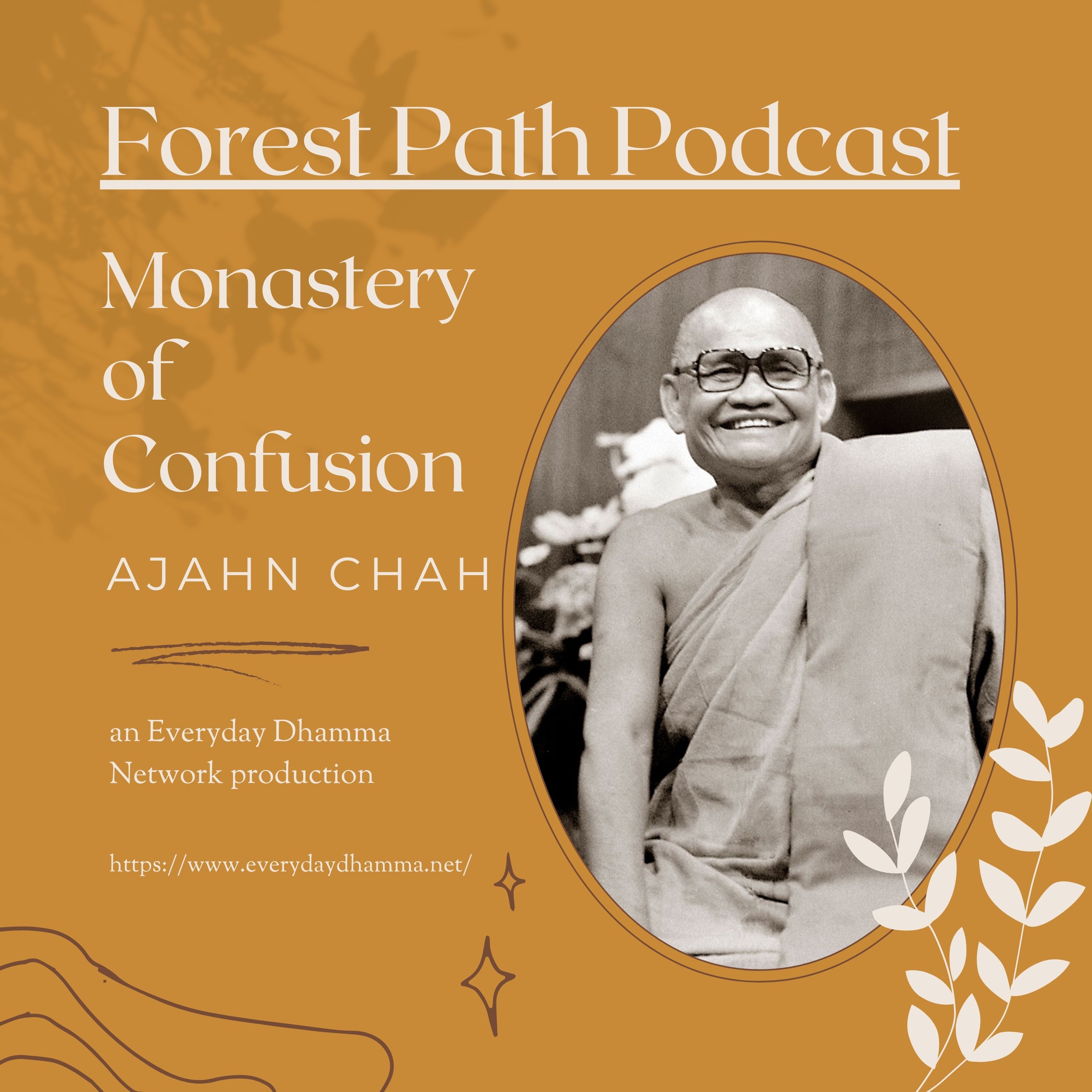
[00:00:08] This episode is a talk given by Ajahn Chah. It's called Monastery of Confusion.
[00:00:15] It was published as part of the Collected Teachings of Ajahn Chah.
[00:00:19] You can find the original text in the description below.
[00:00:22] May you all benefit from hearing this gift of Dhamma by a meditation master of the Thai Forest Tradition.
[00:00:37] Monastery of Confusion by Ajahn Chah Staying or going is not important, but our thinking is.
[00:00:46] So all of you please work together, cooperate, and live in harmony.
[00:00:52] This should be the legacy you create here at Wat Pha Nanachat, Bang Wai, the International Forest Monastery of Bang Wai District.
[00:01:01] Don't let it become Wat Pha Nanachat Wunwai, the International Forest Monastery of Confusion and Trouble.
[00:01:09] Whoever comes to stay here should be helping create this legacy.
[00:01:14] The way I see it, the lay people are providing robes, material alms, food, the dwelling place, and medicines in appropriate measure.
[00:01:24] It's true that they are simple country folk, but they support you out of their faith as best they can.
[00:01:31] Don't get carried away with your ideas of how you think they should be. Such as, oh, I try to teach these lay people, but they do make me upset. Today is the observance day and they came to take precepts. Then tomorrow they'll go casting their fishing nets. They'll drink their whiskey.
[00:01:50] They do these things right out there where anyone can see them.
[00:01:54] Then the next observance day, they'll come again.
[00:01:56] They'll take the precepts and listen to Adhamma talk again. And then they'll go out and put out their nets again, kill animals again, and drink again.
[00:02:07] You can get pretty upset thinking like this.
[00:02:10] You'll think that your activities with the laypeople don't bring any benefit at all.
[00:02:15] Today they take the precepts and tomorrow they go cast fishing nets.
[00:02:20] A monk without much wisdom might get discouraged and feel he's failed, thinking his work bears no fruit.
[00:02:28] But it's not that his efforts have no result.
[00:02:31] It's those lay people who get no result.
[00:02:34] Of course, there is some good result from making efforts at virtue.
[00:02:38] So when there is such a situation and we start to suffer over it, we'll what should we do?
[00:02:45] We contemplate within ourselves to recognize that our good intentions have brought some benefit and do have meaning.
[00:02:52] It's just that the spiritual faculties of these people aren't developed, they aren't strong yet.
[00:02:59] That's how it is for now.
[00:03:00] So we patiently continue to advise them.
[00:03:04] If we just give up on such people, they are likely to become worse than they are now.
[00:03:09] If we keep at it, they may come to maturity one day and recognize their unskillful actions.
[00:03:16] Then they will feel some remorse and start to be ashamed of doing such things.
[00:03:21] Right now they have the faith to support us with material offerings, giving us our requisites for living.
[00:03:29] I've considered this. It's quite a big deal. It's no small thing.
[00:03:34] Donating our food, our dwellings, the medicines to treat our illnesses, is not a small thing.
[00:03:41] We are practicing for the attainment of Debbana.
[00:03:45] If we don't have any food to eat, that will be pretty difficult. How would we sit in meditation?
[00:03:51] How would we be able to build this monastery?
[00:03:55] We should recognize when people's spiritual faculties are not yet mature.
[00:04:00] So what should we do?
[00:04:02] We are like someone selling medicine.
[00:04:05] You've probably seen or heard them driving around with their loudspeakers, touting the different medicines they have for different maladies.
[00:04:12] People who have bad headaches or poor digestion might come to buy.
[00:04:17] We can accept money from those who buy our medicine. We don't take money from someone who doesn't buy anything.
[00:04:24] We can feel glad about the people who do buy something.
[00:04:28] If others stay in their houses and don't come out to buy, we shouldn't get angry with them for that. We shouldn't criticise them.
[00:04:36] If we teach people but they can't properly practice, we shouldn't be getting angry with them. Don't do that. Don't criticise them, but rather keep on instructing them and leading them along.
[00:04:49] Whenever their faculties have ripened sufficiently, then they will want to do it.
[00:04:55] Just like when we are selling medicine, we just keep on doing our business.
[00:04:59] When people have ailments that trouble them, they will buy.
[00:05:02] Those who don't see a need to buy medicine probably aren't suffering from any such condition.
[00:05:07] So never mind keeping at it with this attitude. These problems will be done with.
[00:05:13] There were such situations in the Buddha's times too.
[00:05:18] We want to do it right, but somehow we can't get there yet. Our own faculties are not sufficiently mature. Our parami are not complete. It's like fruit that's still growing on the tree.
[00:05:29] You can't force it to be sweet. It's still unripe. It's small and sour. Simply because it hasn't finished growing.
[00:05:38] You can't force it to be bigger, to be sweet, to be ripe, you have to let it ripen according to its nature.
[00:05:46] As time passes and things change.
[00:05:48] People may come to spiritual maturity.
[00:05:52] As time passes, the fruit will grow, ripen and sweeten of its own accord.
[00:05:57] With such an attitude, you can be at ease.
[00:06:00] But if you are impatient and dissatisfied, you keep asking, why isn't this mango sweet yet? Why is it sour?
[00:06:09] It's still sour because it's not ripe.
[00:06:12] That's the nature of fruit.
[00:06:15] The people in the world are like that. It makes me think of the Buddha's teaching about four kinds of lotus.
[00:06:22] Some are still in the mud, some have grown up out of the mud but are under the water.
[00:06:27] Some are on the surface of the water, and some have risen above the water and blossomed.
[00:06:32] The Buddha was able to give his teachings to so many various beings because he understood their different levels of spiritual development.
[00:06:41] We should think about this and not feel oppressed by what happens here.
[00:06:45] Just consider yourself to be someone selling medicine.
[00:06:49] Your responsibility is to advertise it and make it available.
[00:06:53] If someone gets sick, they are likely to come and buy it.
[00:06:57] Likewise, if people's spiritual faculties mature sufficiently one day, they are likely to develop faith.
[00:07:04] It's not something we can force them to do.
[00:07:08] Seeing it in this way, we will be okay.
[00:07:11] Living here in this monastery is certainly meaningful.
[00:07:15] It's not without benefit.
[00:07:17] All of you, please practice together harmoniously and amicably.
[00:07:22] When you experience obstacles and suffering, recollect the virtues of the Buddha.
[00:07:27] What was the knowledge the Buddha realized?
[00:07:30] What did the Buddha teach?
[00:07:33] What does the Dhamma point out?
[00:07:35] How does the Sangha practice?
[00:07:38] Constantly recollecting the qualities of the three jewels brings a lot of benefit.
[00:07:43] Whether you are Thais or people from other countries is not important.
[00:07:47] It's important to maintain harmony and work together.
[00:07:51] People come from all over the to visit this monastery. When folks come to Wat Phapong, I urge them to come here to see the monastery, to practice here.
[00:08:00] It's a legacy you are creating.
[00:08:02] It seems that the populace have faith and are gladdened by it. So don't forget yourselves.
[00:08:08] You should be leading people rather than being led by them.
[00:08:12] Make your best efforts to practice well and establish yourselves firmly and good results will come.
[00:08:19] Are there any doubts about practice you need to resolve now?
[00:08:26] When the mind isn't thinking much, but is in a sort of dark and dull state, is there something we should do to brighten it? Or should we just sit with it?
[00:08:37] Is this all the time or when are you sitting in meditation?
[00:08:41] What exactly is the darkness like? Is it a lack of wisdom?
[00:08:48] When I sit to meditate, I don't get drowsy. But my mind feels dark, a sort of dense or opaque.
[00:08:58] So you would like to make your mind wise, right?
[00:09:01] Change your posture and do a lot of walking meditation.
[00:09:05] That's one thing to do. You can walk for three hours at a time until you're really tired.
[00:09:12] I do walking meditation a couple of hours a day and I usually have a lot of thinking when I do it.
[00:09:18] But what really concerns me is this dark state when I sit.
[00:09:22] Should I just try to be aware of it and let go? Or is there some means I should use to counter it?
[00:09:30] I think maybe your postures aren't balanced.
[00:09:34] When you walk, you have a lot of thinking, so you should do a lot of discursive contemplation. Then the mind can retreat from thinking.
[00:09:42] It won't stick there.
[00:09:44] But never mind for now. Increase the time you spend on walking meditation. Focus on that. Then if the mind is wandering, pull it out and do some contemplation. Such as, for example, investigation of the body.
[00:09:58] Have you ever done that continuously rather than as an occasional reflection?
[00:10:04] When you experience this dark state, do you suffer over it?
[00:10:09] Question.
[00:10:10] I feel frustrated because of my state of mind. I'm not developing samadhi or wisdom.
[00:10:19] When you have this condition of mind, the suffering comes about because of not knowing.
[00:10:24] There is doubt as to why the mind is like this.
[00:10:27] The important principle in meditation is that whatever occurs, don't be in doubt over it. Doubt only adds to the suffering.
[00:10:35] If the mind is bright and awake, don't doubt that it's a condition of the mind. If it's dark and dull, don't doubt about that. Just continue to practice diligently without getting caught up in reactions to that state.
[00:10:49] Take note and be aware of your state of mind.
[00:10:52] Don't have doubts about is just what it is.
[00:10:56] When you entertain doubts and start grasping at it and giving it meaning, then it is dark as you practice. These states are things you encounter as you progress along.
[00:11:08] You needn't have doubts about them. Notice them with awareness and keep letting go.
[00:11:13] How about sleepiness?
[00:11:15] Is your sitting more sleepy or awake?
[00:11:19] Maybe it's hard to recall if you've been sleepy.
[00:11:22] If this happens, meditate with your eyes open. Don't close them.
[00:11:27] Instead, you can focus your gaze on one point, such as the light of a candle.
[00:11:31] Don't close your eyes.
[00:11:33] This is one way to remove the hindrance of drowsiness.
[00:11:37] When you're sitting, you can close your eyes from time to time. And if the mind is clear without drowsiness, you can then continue to Sit with your eyes closed. If it's dull and sleepy, open your eyes and focus on one point.
[00:11:52] It's similar to Cassina meditation.
[00:11:55] Doing this, you can make the mind awake and tranquil.
[00:11:58] The sleepy mind isn't tranquil. It's obscured by hindrance and it's in darkness.
[00:12:05] We should talk about sleep also.
[00:12:08] You can't simply go without sleep. It's the nature of the body.
[00:12:11] If you're meditating and you get unbearably, utterly sleepy, then let yourself sleep.
[00:12:17] This is one way to quell the hindrance when it's overwhelming you.
[00:12:21] Otherwise, you practice along, keeping the eyes open. If you have this tendency to get drowsy, close your eyes after a while and check your state of mind.
[00:12:31] If it's clear, you can practice with eyes closed.
[00:12:34] Then after some time, take a rest.
[00:12:37] Some people are always fighting against sleep. They force themselves not to sleep, and the result is that when they sit, they are always drifting off to sleep and falling over themselves.
[00:12:47] Sitting in an unaware state.
[00:12:52] Can we focus on the tip of the nose?
[00:12:56] That's fine. Whatever suits you, whatever you feel comfortable with and helps you fix your mind, focus on that.
[00:13:05] It's like if we get attached to the ideals and take the guidelines that we are given in the instructions too literally, it can be difficult to understand when doing a standard meditation such as mindfulness or breathing. First we should make the determination that right now we are going to do this practice and we are going to make mindfulness of breathing our foundation.
[00:13:27] We only focus on the breath at three points as it passes through the nostrils, the chest and the abdomen.
[00:13:34] When the air enters, it first passes the nose, then through the chest, then to the end point of the abdomen as it leaves the body. The beginning is the abdomen, the middle of this is the chest, and the end is the nose.
[00:13:48] We merely note it. This is a way to start controlling the mind, tying awareness to these points at the beginning, middle and end of the inhalations and exhalations.
[00:13:59] Before we begin, we should first sit and let the mind relax.
[00:14:03] It's similar to sewing robes on a treadle sewing machine.
[00:14:07] When we are learning to use the sewing machine, first we just sit in front of the machine to get familiar with it and feel comfortable.
[00:14:15] Here we just sit and breathe, not fixing awareness on anything. We merely take note that we are breathing.
[00:14:22] We take note of whether the breath is relaxed or not and how long or short it is.
[00:14:27] Having noticed this, then we begin focusing on the inhalation and exhalation at the three points.
[00:14:34] We practice like this until we become skilled in it and it goes smoothly.
[00:14:39] The next stage is to focus awareness only on the sensation of the breath at the tip of the nose or the upper lip.
[00:14:46] At this point, we aren't concerned with whether the breath is long or short, but only focus on the sensation of entering and exiting.
[00:14:54] Different phenomena may contact the senses or thoughts may arise.
[00:14:58] This is called initial thought.
[00:15:02] The mind brings up some idea, be it about the nature of compounded phenomena, about the world or whatever.
[00:15:10] Once the mind has brought it up, the mind will want to get involved and merge with it.
[00:15:15] If it's an object that is wholesome, let the mind take it up.
[00:15:19] If it is something unwholesome, stop it immediately.
[00:15:23] If it is something wholesome, let the mind contemplate it and gladness, satisfaction and happiness will come about.
[00:15:30] The mind will be bright and clear as the breath goes in and out and the mind takes up these initial thoughts.
[00:15:37] Then initial thought becomes discursive thought. Vichara the mind develops familiarity with the object, exerting itself and merging with it.
[00:15:47] At this point, there is no sleepiness.
[00:15:50] After an appropriate period of this, take your attention back to the breath.
[00:15:55] As you continue on, there will be initial thought and discursive thought.
[00:16:00] Initial thought and discursive thought.
[00:16:03] If you are contemplating skillfully on an object such as the nature of Sankara, the mind will experience deeper tranquility and rapture is born.
[00:16:13] There is the vitaka and Vichara and that leads to happiness of mind.
[00:16:18] At this time, there won't be any dullness or drowsiness.
[00:16:22] The mind won't be dark. If we practice like this, it will be gladdened and enraptured.
[00:16:28] This rapture will start to diminish and disappear after a while. So you can take up initial thought again.
[00:16:35] The mind will become firm and certain with it undistracted.
[00:16:40] Then you go on to discursive thought again. The mind becoming one with it.
[00:16:44] When you are practicing a meditation that suits your temperament and doing it well, then whenever you take up the object, rapture will come about.
[00:16:53] The hairs of the body stand on end and the mind is enraptured and satiated.
[00:16:58] When it's like this, there can't be any dullness or drowsiness. You won't have any doubts back and forth between initial and discursive thought, initial and discursive thought over and over again. And rapture comes.
[00:17:13] Then there is Sukha.
[00:17:16] This takes place in sitting practice.
[00:17:18] After sitting for a while, you can get up and do walking meditation.
[00:17:22] The mind can be the same in the walking not sleepy. It has vitaka and Vichara. Vitaka and Vichara. Then rapture.
[00:17:31] There won't be any of the Nirvarana and the mind will be unstained.
[00:17:37] Whatever takes place, never mind. You don't need to doubt about any experiences you may have.
[00:17:43] Be they of light, of bliss or whatever.
[00:17:46] Don't entertain doubts about the conditions of the mind.
[00:17:49] If the mind is dark, if the mind is illumined, don't fixate on these conditions. Don't be attached to them.
[00:17:57] Let go, discard them.
[00:17:59] Keep walking. Keep noting what is taking place without getting bound or infatuated.
[00:18:06] Don't suffer over these conditions of mind.
[00:18:09] Don't have doubts about them.
[00:18:11] They are just what they are, following the way of mental phenomena.
[00:18:16] Sometimes the mind will be joyful, sometimes it will be sorrowful.
[00:18:20] There can be happiness or suffering. There can be obstruction.
[00:18:24] Rather than doubting, understand that conditions of mind are like this.
[00:18:29] Whatever manifests is coming about due to causes ripening.
[00:18:34] At this moment, this condition is manifesting. That's what you should recognize.
[00:18:39] Even if the mind is dark, you don't need to be upset over that. If it becomes bright, don't be excessively gladdened by that.
[00:18:48] Don't have doubts about these conditions of mind or about your reactions to them.
[00:18:53] Do your walking meditation until you are really tired. Then sit.
[00:18:57] When you sit, determine your mind to sit. Don't just play around.
[00:19:02] If you get sleepy, open your eyes and focus on some object.
[00:19:06] Walk until the mind separates itself from thoughts and is still.
[00:19:10] Then sit.
[00:19:11] If you are clear and awake, you can close your eyes.
[00:19:15] If you get sleepy again, open your eyes and look at an object.
[00:19:20] Don't try to do this all day and all night. When you're in need of sleep, let yourself sleep. Just as with our food, once a day we eat. The time comes and we give food to the body.
[00:19:32] The need for sleep is the same. When the time comes, give yourself some rest.
[00:19:37] When you've had an appropriate rest, get up.
[00:19:40] Don't let the mind languish in dullness. But get up and get to work. Start practicing.
[00:19:46] Do a lot of walking meditation. If you walk slowly and the mind becomes dull, then walk fast.
[00:19:53] Learn to find the right practice for yourself.
[00:19:59] Are Vitaka and Vichara the same?
[00:20:03] You're sitting and suddenly the thought of someone pops into your head. That's vitaka, the initial thought.
[00:20:10] Then you take that idea of the person and start thinking about them in detail.
[00:20:15] Vitaka picks up the idea. Vicara investigates it. For example, we pick up the idea of death and then we start considering it. I will die, others will die, every living being will die. When they die, where will they go then? Stop. Stop and bring it back again.
[00:20:34] When it gets running like that, stop it again and then go back to mindfulness of the breath.
[00:20:40] Sometimes the discursive thought will wander off and not come back. So you have to stop it.
[00:20:46] Keep at it until the mind is bright and clear.
[00:20:49] If you practice Vichara with an object that you are suited to, you may experience the hairs of your body standing on end, tears pouring from your eyes, a state of extreme delight.
[00:21:01] Many different things occur as rapture comes.
[00:21:07] Can this happen with any kind of thinking? Or is it only in a state of tranquillity that it happens?
[00:21:15] It's when the mind is tranquil.
[00:21:18] It's not ordinary mental proliferation.
[00:21:21] You sit with a calm mind and then the initial thought comes.
[00:21:25] For example, I think of my brother who just passed away, or I might think of some other relatives.
[00:21:32] This is when the mind is tranquil. The tranquility isn't something certain. But for the moment, the mind is tranquil.
[00:21:39] After this initial thought comes, I go into discursive thought. If it's a line of thinking that's skilful and wholesome, it leads to ease of mind and happiness. And there is rapture with its attendant experiences.
[00:21:54] This rapture came from the initial and discursive thinking that took place in a state of calmness.
[00:22:01] We don't have to give it names, such as first jhana, second jhana, and so forth. We just call it tranquility.
[00:22:08] The next factor is bliss.
[00:22:11] Eventually we drop the initial and discursive thinking as tranquillity deepens.
[00:22:16] Why?
[00:22:17] The state of mind is becoming more refined and subtle.
[00:22:21] Vitaka and vicara are relatively coarse and they will vanish.
[00:22:26] There will remain just the rapture, accompanied by bliss and one pointedness of mind.
[00:22:32] When it reaches full measure, there won't be anything. The mind is empty.
[00:22:37] There's absorption, concentration.
[00:22:40] We don't need to fixate or dwell on any of these experiences. They will naturally progress from one to the next.
[00:22:48] At first there is initial and discursive thought, rapture, bliss and one pointedness.
[00:22:54] Then initial and discursive thinking are thrown off, leaving rapture, bliss and one pointedness.
[00:23:01] Rapture is thrown off, then bliss and finally only one pointedness and equanimity remains.
[00:23:08] It means the mind becomes more and more tranquil and its objects are steadily decreasing until there is nothing but one pointedness and equanimity.
[00:23:18] When the mind is tranquil and focused, this can happen.
[00:23:22] It is the Power of mind. The state of the mind that has attained tranquillity.
[00:23:27] When it's like this, there won't be any sleepiness.
[00:23:31] It can't enter the mind, it will disappear.
[00:23:34] The other hindrances of sensual desire, aversion, doubt and restlessness and agitation won't be present.
[00:23:42] Though they may still exist latent in the mind of the meditator, they won't occur at this time.
[00:23:50] Should we be closing our eyes so as to shut out the external environment?
[00:23:54] Or should we just deal with the things as we see them?
[00:23:57] Is it important whether we open or close out the eyes?
[00:24:03] When we are new to training, it's important to avoid too much sensory input. So it's better to close the eyes.
[00:24:11] Not seeing objects that can distract and affect us. We build up the mind's strength.
[00:24:16] When the mind is strong, then we can open the eyes and whatever we see won't sway us.
[00:24:22] Open or closed won't matter.
[00:24:24] When you rest, you normally close your eyes.
[00:24:27] Sitting in meditation with eyes closed is the dwelling place for a practitioner.
[00:24:33] We find enjoyment and rest in it.
[00:24:36] This is an important basis for us. But when we are not sitting in meditation, will we be able to deal with these things?
[00:24:45] We sit with eyes closed and we profit from that.
[00:24:48] When we open our eyes and leave the formal meditation, we can handle whatever we meet.
[00:24:54] Things won't get out of hand. We won't be at a loss.
[00:24:58] Basically, we are just handling things.
[00:25:01] It's when we go back to our sitting that we really developed greater wisdom.
[00:25:06] This is how we develop the practice.
[00:25:08] When it reaches fulfillment, it doesn't matter whether we open or close our eyes.
[00:25:14] It will be the same.
[00:25:15] The mind won't change or deviate.
[00:25:18] At all times of day, morning, noon or night, the state of mind will be the same.
[00:25:24] We dwell thus.
[00:25:26] There is nothing that can shake the mind.
[00:25:28] When happiness arises, we recognize it's not certain and it passes.
[00:25:34] Unhappiness arises and we recognize it's not certain.
[00:25:38] And that's that.
[00:25:40] You get the idea that you want to disrobe. This is not certain.
[00:25:45] But you think it's certain. Before you wanted to be ordained and you were so sure about that.
[00:25:50] Now you are sure you want to disrobe.
[00:25:53] It's all uncertain, but you don't see it because you're darkness of mind.
[00:25:58] Your mind is telling you lies.
[00:26:00] Being here, I'm only wasting time.
[00:26:04] If you disrobe and go back to the world, won't you waste time there?
[00:26:09] You don't think about that. Disrobing to work in the fields and gardens to grow beans or raise pigs and goats.
[00:26:15] Won't that be a waste of time?
[00:26:18] There was once a large pond full of fish. As time passed, the rainfall decreased and the pond became shallow.
[00:26:26] One day, a bird showed up at the edge of the pond. He told the fish, I really feel sorry for you fish. Here you barely have enough water to keep your backs wet.
[00:26:36] Do you know that not very far from here there's a big lake several meters deep, where the fish swim happily?
[00:26:43] When the fish in that shallow pond heard this, they got excited. They said to the bird, it sounds good, but how could we get there?
[00:26:51] The bird said, no problem. I can carry you in my bill one at a time.
[00:26:56] The fish discussed this amongst themselves.
[00:26:59] It's not so great here anymore. The water doesn't even cover our heads. We ought to go.
[00:27:05] So they lined up to be taken by the bird.
[00:27:07] The bird took one fish at a time.
[00:27:10] As soon as he flew out of sight of the pond, he landed and ate the fish. Then he would return to the pond and tell them, your friend is right this moment swimming happily in the lake. And he asks when you will be joining him.
[00:27:24] It sounded fantastic to the fish.
[00:27:26] They couldn't wait to go. So they started pushing to get to the head of the line.
[00:27:31] The bird finished off the fish like that. Then he went back to the pond to see if he could find any more. There was only one crab there. So the bird started his sales pitch about the lake.
[00:27:41] The crab was skeptical. He asked the bird how he could get there.
[00:27:46] The bird told him he would carry him in his bill. But this crab had some wisdom. He told the bird, let's do it like this. I'll sit on your back with my arms around your neck. If you try any tricks, I'll choke you with my claws.
[00:28:00] The bird felt frustrated by this. But he gave it a try, thinking he might still somehow get to eat the crab. So the crab got on his back and they took off.
[00:28:10] The bird flew around looking for a good place to land. But as soon as he tried to descend, the crab started squeezing his throat with his claws.
[00:28:19] The bird couldn't even cry out. He just made a dry, croaking sound.
[00:28:23] So in the end, he had to give up and return the crab to the pond.
[00:28:28] I hope you have the wisdom of the crab.
[00:28:31] If you are like those fish, you will listen to the voices that tell you how wonderful everything will be if you go back to the world.
[00:28:38] That's an obstacle obtained people meet with.
[00:28:42] Please be careful about this.
[00:28:47] Why is it that unpleasant states of mind are difficult to see clearly, while pleasant states are easy to see.
[00:28:53] When I experience happiness or pleasure, I can see that it's something impermanent. But when I'm unhappy, that's harder to see.
[00:29:02] You are thinking in terms of your attraction and aversion and trying to figure it out. But actually delusion is the predominant root.
[00:29:10] You feel that unhappiness is hard to see, whilst happiness is easy to see.
[00:29:15] That's just the way your afflictions work.
[00:29:18] Aversion is hard to let go of, right?
[00:29:21] It's a strong feeling. You say happiness is easy to let go of. It's not really easy. It's just that it's not so overpowering.
[00:29:29] Pleasure and happiness are things people like and feel comfortable with.
[00:29:33] They're not so easy to let go of.
[00:29:36] Aversion is painful, but people don't know how to let go of it.
[00:29:39] The truth is that they are equal. When you contemplate thoroughly and get to a certain point, you will quickly recognize that they're equal. If you had a scale to weigh them, their weight would be the same.
[00:29:51] But we incline towards the pleasurable.
[00:29:55] Are you saying that you can let go of happiness easily while unhappiness is difficult to let go of?
[00:30:00] You think that the things we like are easy to give up, but you're wondering why. The things we dislike are hard to give up.
[00:30:08] But if they're not good, why are they hard to give up?
[00:30:12] It's not like that. Think anew. They are completely equal. It's just that we don't incline to them equally.
[00:30:20] When there is unhappiness, we feel bothered. We want it to go away quickly, so we feel it's hard to get rid of.
[00:30:26] Happiness doesn't usually bother us, so we are friends with it and feel we can let go of it easily.
[00:30:32] It's not like that. It's not oppressing and squeezing our hearts, that's all.
[00:30:36] Unhappiness oppresses us. We think one has more value and weight than the other, but in truth they are equal. It's like heat and cold. We can be burned to death by fire, but we can also be frozen stiff by cold and we die just the same.
[00:30:52] Neither is greater than the other.
[00:30:54] Happiness and suffering are like this. But in our thinking we give them different values.
[00:31:00] Or consider praise and criticism. Do you feel that praise is easy to let go of and criticism harder to let go of?
[00:31:07] They are really equal.
[00:31:09] But when we are praised, we don't feel disturbed. We are pleased, but it's not a sharp feeling.
[00:31:15] Criticism is painful, so we feel it's hard to let go of.
[00:31:19] Being pleased is also hard to let go of. But we are partial to it. So we don't have the same desire to get rid of it quickly.
[00:31:27] The delight we take in being praised and the sting we feel when criticized are equal.
[00:31:32] They are the same.
[00:31:33] But when our minds meet these things, we have unequal reactions to them. We don't mind being close to some of them.
[00:31:42] Please understand this. In our meditation, we will meet with the arising of all sorts of mental afflictions.
[00:31:49] The correct outlook is to be ready to let go of it all, whether pleasant or painful.
[00:31:54] Even though happiness is something we desire and suffering is something we don't desire, we recognize they are of equal value.
[00:32:01] These are things that we will experience.
[00:32:04] Happiness is wished for by people in the world.
[00:32:07] Suffering is not wished for. Nibbana is something beyond wishing and not wishing.
[00:32:13] Do you understand?
[00:32:14] There is no wishing involved in Nibbana.
[00:32:17] Wanting to get happiness, wanting to be free of suffering, wanting to transcend happiness and suffering.
[00:32:24] There are none of these things.
[00:32:26] It is peace.
[00:32:28] As I see it, realizing the truth doesn't happen by relying on others.
[00:32:32] You should understand that all doubts will be resolved by our own efforts. By continuous, energetic practice. We won't get free of doubt by asking others. We will only end doubt through our own unrelenting efforts.
[00:32:46] Remember this. It's an important principle in practice. The actual doing is what will instruct you. You will come to know all right and wrong.
[00:32:55] The Brahmin shall reach the exhaustion of doubt through unceasing practice.
[00:33:00] It doesn't matter wherever we go, everything can be resolved through our own ceaseless efforts.
[00:33:07] But we can't stick with it. We can't bear the difficulty we meet. We find it hard to face up to our suffering and and not to run away from it.
[00:33:15] If we do face it and bear with it, then we gain knowledge and the practice starts instructing us automatically, teaching us about right and wrong and the way things really are.
[00:33:26] Our practice will show us the faults and ill results of wrong thinking. It really happens like this.
[00:33:32] But it's hard to find people who can see it through.
[00:33:36] Everyone wants instant awakening, rushing here and there, following your impulses. You only end up worse off for it.
[00:33:44] Be careful about this.
[00:33:47] I have often taught that tranquillity is stillness, flowing is wisdom.
[00:33:52] We practice meditation to calm the mind and make it still.
[00:33:56] Then it can flow.
[00:33:58] In the beginning, we learn what still water is like and what flowing water is like.
[00:34:03] After practicing for a While we will see how these two support each other, we have to make the mind calm like still water.
[00:34:11] Then it flows.
[00:34:13] Both being still and flowing, this is not easy to contemplate. We can understand that still water doesn't flow. We can understand that flowing water isn't still.
[00:34:24] But when we practice, we take hold of both of these.
[00:34:28] The mind of a true practitioner is still water that flows or flowing water that's still.
[00:34:35] Whatever takes place in the mind of a Dhamma practitioner is like flowing water. That is still.
[00:34:41] To say that it is only flowing is not correct. To say it is only still is not correct.
[00:34:47] Ordinarily, still water is still and flowing water flows. But when we have experience of practice, our minds will be in this condition of flowing water that is still.
[00:34:58] This is something we have never seen.
[00:35:01] When we see flowing water, it is just flowing along.
[00:35:04] When we see still water, it doesn't flow.
[00:35:07] But within our minds, it will really be like this. Like flowing water that is still.
[00:35:13] In our Dhamma practice, we have samadhi or tranquility and wisdom mixed together.
[00:35:19] We have morality, meditation and wisdom.
[00:35:23] Then wherever we sit, the mind is still and it flows still. Flowing water with meditative stability and wisdom, tranquility and insight. It's like this.
[00:35:35] The Dhamma is like this. If you have reached the Dhamma, then at all times you will have this experience.
[00:35:42] Being tranquil and having wisdom. Flowing, yet still, still, yet flowing.
[00:35:50] Whenever this occurs in the mind of one who practices in it is something different and strange.
[00:35:56] It is different from our ordinary mind that one has known all along.
[00:36:00] Before, when it was flowing, it flowed. When it was still, it didn't flow, but was only still.
[00:36:08] The mind can be compared to water in this way.
[00:36:11] Now it has entered a condition that is like flowing water. Being still, whether standing, walking, sitting or lying down, it is like water that flows, yet is still.
[00:36:22] If we make our minds like this, there is both tranquillity and wisdom.
[00:36:27] What is the purpose of tranquillity? Why should we have wisdom?
[00:36:32] They are only for the purpose of freeing ourselves from suffering, nothing else.
[00:36:37] At present, we are suffering, living with dukkha, not understanding dukkha and therefore holding onto it. But if the mind is as I've been speaking about, there will be many kinds of knowledge.
[00:36:50] One will know suffering, know the cause of suffering, know the cessation of suffering, and know the way of practice to reach the ending of suffering.
[00:36:59] These are the noble truths. They will appear of themselves when there is still flowing water.
[00:37:06] When it is like this, then no matter what we are doing, we will have no heedlessness. The habit of heedlessness will weaken and disappear.
[00:37:15] Whatever we experience, we won't fall into heedlessness because the mind will naturally hold fast to the practice.
[00:37:22] It will be afraid of losing the practice.
[00:37:25] As we keep on practicing and learning from experience, we will be drinking of the Dhamma more and more, and our faith will keep increasing.
[00:37:34] For one who practices, it has to be like this. We shouldn't be the kind of people who merely follow others.
[00:37:41] If our friends aren't doing the practice, we won't do it either because we would feel embarrassed. If they stop, we stop. If they do it, we do it. If the teacher tells us to do something, we do it. If he stops, we stop.
[00:37:56] This is not a very quick way of realization.
[00:38:00] What's the point of our training here?
[00:38:02] It's so that when we are alone, we will be able to continue with the practice.
[00:38:08] So now, while living together here, when there are morning and evening gatherings to practice, we join in and practice with the others.
[00:38:16] We build up the habits so that the way of practice is internalized in our hearts. And then we will be able to live anywhere and still practice in the same way.
[00:38:25] It's like having a certificate of guarantee. If the king is coming here, we prepare everything as perfectly as we can.
[00:38:33] He stays a short while and then goes on his way. But he gives his royal seal to acknowledge that things are in order here.
[00:38:40] Now many of us are practicing together, and it's time to learn the practice well, to understand it and internalize it, so that each of you can be a witness to yourself.
[00:38:51] It's like children coming of age.
[00:39:01] That concludes the Dhamma teaching by the venerable Ajahn Chah.
[00:39:05] If you'd like to hear more talks by Ajahn Chah and other meditation masters of the forest tradition of Theravada Buddhism, subscribe to the Forest Path podcast using your favourite podcast app.
[00:39:17] Thank you for listening. May you all experience insight and peace.